Let’s be honest for a second. We’ve all spent the last decade chasing the Google dragon. We’ve obsessed over backlinks, we’ve fought over keyword rankings like they were holy relics, and we’ve convinced ourselves that as long as we were on the first page, the business was safe.
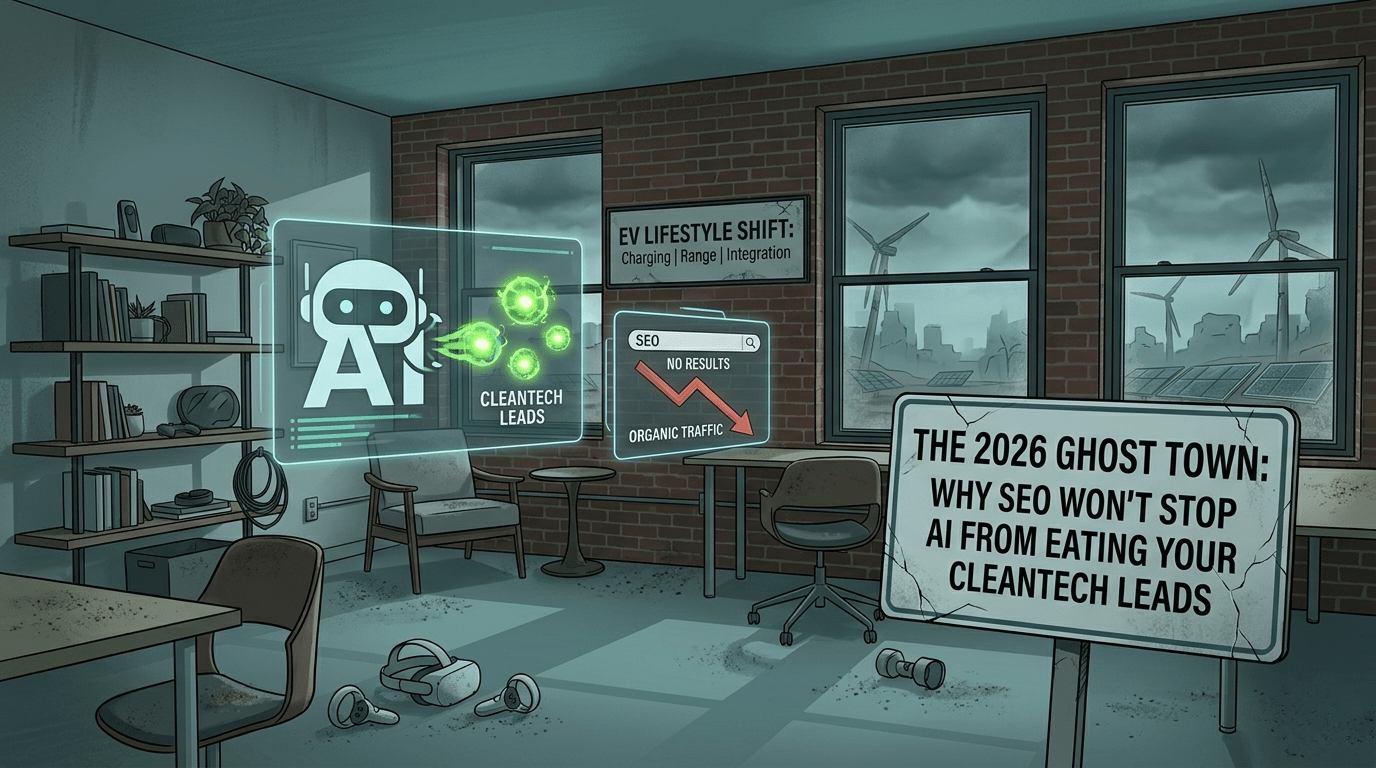
But here is the cold, hard truth that most agencies are too scared to tell you. in 2026, the first page of a search result is not going to look anything like it used to. For the cleantech sector, where the products are complex and the sales cycles are long, the traditional blue link search is becoming a ghost town.
Think about how you actually find information lately. If you are trying to understand the nuances of long-duration energy storage or the carbon intensity of a specific microgrid setup, are you really clicking through ten different websites and reading three-thousand-word fluff pieces?
Or are you asking an AI to synthesize the data and give you a straight answer? The answer engine is not coming. It is already here. And if your marketing strategy is still built on the old-school SEO playbook, you are essentially building a high-speed highway that leads to a dead end.
I hear people saying SEO is dead every six months. It is not dead. But its job description has changed. In 2026, your traditional SEO is the plumbing. It is the infrastructure. It is the reason the librarian, those AI models like ChatGPT, Gemini, or whatever comes next, can actually find your books in the first place.
This is what we call Retrieval-Augmented Generation. When an AI tries to answer a buyer’s question, it does not just pull things out of thin air.
It searches an index, grabs bits of info from trusted sources, and stitches them together. If your site’s technical SEO is a mess, if your pages are slow, your metadata is non-existent, or your site structure is a maze, the AI is just going to skip you. It is too much work.
But even if your plumbing is perfect, if your content is just a recycled version of what everyone else is saying, the AI has no reason to cite you. It already has that information.
This is where most cleantech firms are failing. They are publishing commodity content.
If you want to survive 2026, you have to move into Generative Engine Optimization. This is not about ranking for solar panels. It is about being the definitive source that the AI feels obligated to mention.
To do that, you need what I call Information Gain.
If I am a buyer asking an AI to compare hydrogen electrolyzer efficiencies, and your website is the only one providing raw, proprietary data from a real-world pilot project in the Mojave, the AI has to cite you.
You have given it something new. Something it could not get from a Wikipedia scrape or a generic blog post. This is the shift from being a writer to being a source.
We are moving toward a world of Entity Mapping. AI engines are building a web of trust. They want to know who is the actual authority on solid-state batteries. They look for your brand name mentioned in research papers, in high-tier trade journals, and in structured data tables. They are looking for a footprint, not just a keyword.
I specialize in the intersection of tech and human behavior, and I have noticed that cleantech is uniquely vulnerable to this AI shift.
Your stuff is hard to understand. B2B buyers in this space are overwhelmed. They are dealing with massive capital expenditures, shifting regulations, and technical jargon that would make a physicist’s head spin. They want an AI to simplify it for them.
The biggest mistake I see is the PDF graveyard. Cleantech companies love burying their most brilliant insights in fifty-page PDFs. They are beautiful, sure. But to an AI crawler, a PDF is a black box. It is hard to parse, hard to index, and hard to cite.
In 2026, if your data is not in high-performance, structured HTML with clean tables and clear schema markup, you are effectively invisible. You are handing your market share to the competitor who was smart enough to turn their whitepaper into a power page.
You cannot just pick one strategy. You need a hybrid approach that recognizes how humans actually make decisions.
The top of the funnel is for the AI. This is where the discovery happens. This is where you optimize for the answer engine. You want your brand to be the citation. You want the AI to say that according to research by your company, the ROI on VPP integration has increased by a specific percentage.
That is your brand awareness play. The bottom of the funnel is for the humans. Once the AI has pointed them in your direction, the buyer is going to land on your site. And that is where traditional SEO and high-level user experience take over.
They are not there for a summary anymore. They are there to verify you are a real company with real experts and a real product. If you miss the generative side, you never get the discovery. If you miss the traditional side, you never get the conversion. It is a zero-click world at the top, but it is still a high-touch world at the bottom.
If you were sitting in my office today, here is exactly what I would tell you to do.
First, audit your entity. Go ask the major AI models who the leaders are in your specific niche. If your name does not come up, or if the description is wrong, you have a PR and content problem.
You have not left enough digital breadcrumbs. Second, stop writing for bots and start interviewing your experts. I mean it. Get your lead engineer on a call for thirty minutes. Extract the stuff they know that is not on the internet. That hidden knowledge is your information gain. That is what the AI wants to cite.
Next, kill the PDFs. Seriously. Take your best technical assets and turn them into structured web pages. Use clear formatting and tables. Make it so easy for an AI to scrape your data that it would be stupid for it not to use you as a source.
Then, watch the cost per answer. We used to track cost per click. Now, I want you to look at how much effort it takes to become the definitive answer for a high-value query. If it is too easy to replicate, it is not a moat. Build content that is hard to copy.
Finally, embrace the zero-click trend.
Stop panicking because your organic traffic is dipping. Look at your brand mentions. If you are being cited in AI answers, you are winning the battle for mindshare. In 2026, influence is the new traffic.
The next two years are going to be a great filter for cleantech marketing. The companies that keep churning out generic, SEO-optimized garbage are going to find themselves shouting into a void.
The companies that win will be the ones that act like a definitive source of truth. They will be the ones that understand that AI is not stealing their traffic. It is just changing the way humans find answers. The plumbing still matters, but the true value is in the expertise. Do not just try to rank. Try to be the only answer that matters.
This evolution requires a fundamental rethink of what a marketing team even looks like.
You do not just need writers; you need data architects. You need people who understand how to structure a dataset so that it is readable by a machine but still compelling to a human executive.
We are talking about the end of the keyword era and the beginning of the authority era.
In the past, you could trick a search engine with enough backlinks and the right density of phrases. You cannot trick a model that has read the entire internet. It knows when you are faking it. It knows when your content is thin.
The human element here is irony. To satisfy the most advanced machines ever built, we have to become more human. We have to lean into original research, first-person experience, and bold opinions.
We have to stop being afraid of the “I” in our writing. AI can summarize a consensus, but it cannot have a perspective. It cannot tell you what it felt like to stand on a wind farm in the North Sea and see a specific technical failure happen in real-time. That perspective is your shield.
As we approach 2027, the noise is only going to get louder. There will be millions of AI-generated blogs flooding the web every single day. If you are adding to that pile, you are already lost.
Your job is to be the signal in that noise. You do that by being the source of the data that the AI-generated blogs are trying to summarize. You do that by owning the facts. When you own the facts, you own the answer. And when you own the answer, you own the market.
This shift is not just technical; it is psychological. We have to train our stakeholders to look at different numbers. We have to explain why a drop in raw sessions might actually coincide with a rise in high-intent leads coming from AI citations.
We have to move away from the vanity of the traffic graph and toward the reality of the influence graph. It is a brave new world for cleantech, a sector that literally exists to build the future.
It is time your marketing reflected that same forward-thinking DNA. Stop looking at the search results of 2024 and start building for the answer engines of 2026. The window is closing, but for those who move now, the opportunity to define their niche is absolute.