Let us talk about the wild world of clean tech email marketing. If you are selling solar grids, hydrogen fuel cells, or carbon capture tech, you already know you are not just pushing a quick impulse buy. You are navigating notoriously long, complex sales cycles that can take anywhere from six to eighteen months.
Email marketing for clean tech sits right at the intersection of digital marketing and sustainable innovation. It is entirely different from your standard eCommerce or traditional B2B playbook.
You have to nail a tricky balancing act: being highly technically accurate while telling a compelling, emotional story about environmental impact.
A solid email strategy acts as the bridge between prospect skepticism and closed deals, nurturing leads with consistent education and hard proof of both ROI and sustainability.
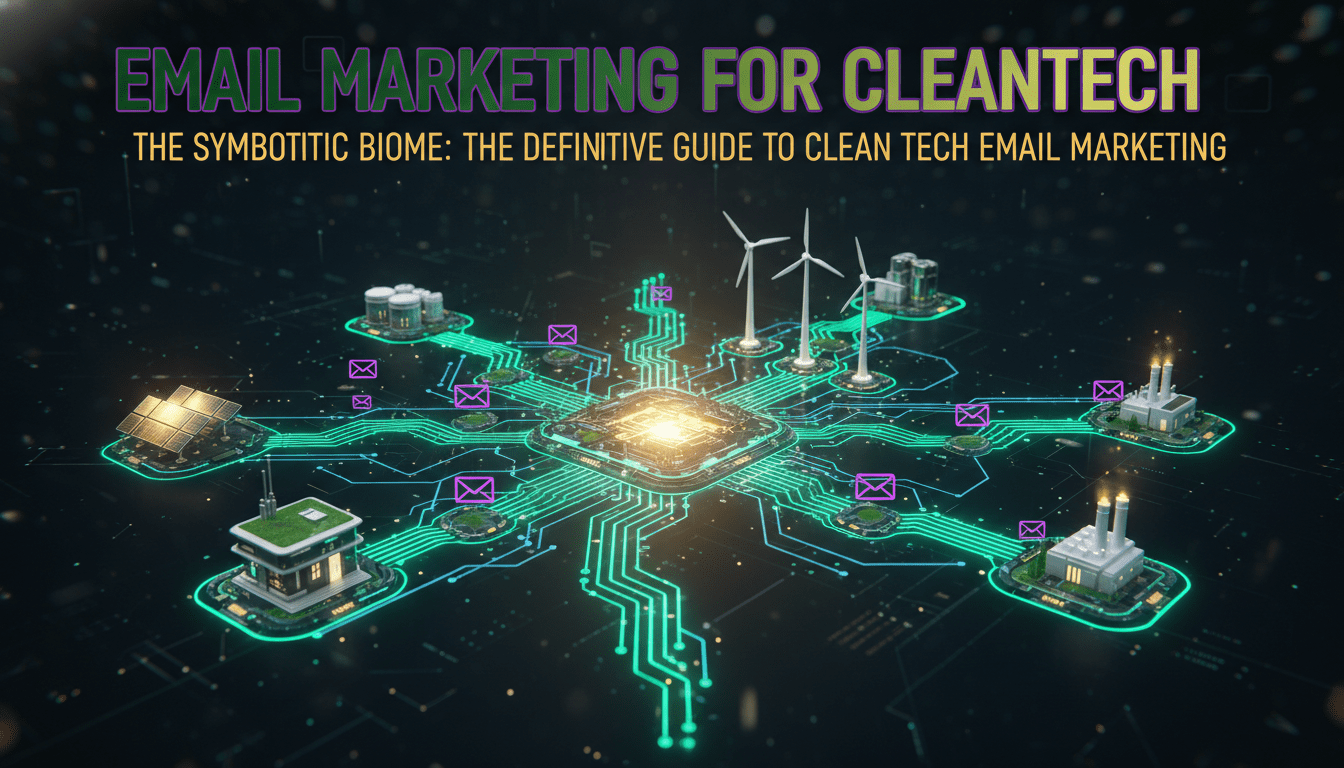
In this guide, we will explore how to master the “Symbiotic Biome” of email—a system where B2B and B2C strategies coexist to drive the green revolution forward.
1. The Dual Nature: B2B vs. B2C in the Green Space
Before we dive into the specific emails, we must acknowledge that “Clean Tech” is a broad church. The way you talk to a CTO of a manufacturing plant (B2B) is fundamentally different from how you talk to a homeowner looking to install a residential battery (B2C).
The B2B Landscape: Logic, Risk, and Regulation
In the B2B sector, your emails are competing with hundreds of other operational priorities. These buyers are risk-averse. They are not just buying a product; they are making a capital expenditure (CAPEX) that will sit on their books for 20 years.
The Motivators: They care about Levelized Cost of Energy (LCOE) regulatory compliance (ESG reporting), and operational uptime.
The Strategy: Your emails must function as a “Consultant in an Inbox.” You are there to help them look good to their board of directors.
Your content should focus on mitigating the risk of transition and proving the long-term fiscal health of the investment. Use technical whitepapers, ROI calculators, and regulatory update briefings.
The B2C Landscape: Savings, Status, and Stewardship
For the B2C consumer, the motivation is often a mix of “wallets and wonders.” They want to save money on their monthly utility bills, but they also want the “Tesla effect”—the status of being an early adopter and the peace of mind that they are protecting the planet for their children.
The Motivators: Monthly savings, energy independence (not being reliant on a failing grid), and carbon footprint reduction.
The Strategy: Your emails should be high-visual, emotive, and easy to digest. Use “You” centered language. Focus on lifestyle integration. How does this tech make their home smarter, cheaper to run, and more resilient? Use stories, high-quality photography, and simple “how-to” videos.
2. The 7 Essential Email Types: A Deep Dive
To thrive, your email ecosystem needs diversity. Here are the seven types of emails every clean tech company needs to deploy, how to use them, and why they work.
Type 1: The “Genesis” Welcome Sequence
The Strategy: This is your first impression. When someone downloads your “Guide to Microgrids” or signs up for your “Green Living” newsletter, the first 48 hours are critical. This is when their interest is highest.
How to use it (The 5-Day Blueprint):
Day 1: The Mission. Why do you exist? (The “Why”). Welcome them to the community and deliver the lead magnet immediately.
Day 2: The Logic. Share a foundational piece of content that explains the problem your tech solves.
Day 3: The Proof. Share a customer testimonial or a quote from a high-authority industry publication.
Day 4: The Objection. Address the biggest question people have (e.g., “What happens when the sun doesn’t shine?”).
Day 5: The Invitation. A low-pressure call to action, like joining a live webinar or using a self-service sizing tool.
Benefit: It establishes immediate authority and sets the tone for a relationship, not just a transaction. It automates the “know, like, and trust” factor.
Type 2: The “Deep Roots” Educational/Nurture Email
The Strategy: Clean tech is complex. If a prospect doesn’t understand the science, they won’t buy the solution.
How to use it: Take one complex topic—say, “The difference between Blue and Green Hydrogen”—and break it down. Use analogies. Compare a battery’s capacity to a water tank. Make the invisible (energy) visible (impact).
B2B Version: Focus on the technical efficiency and the “Total Cost of Ownership.”
B2C Version: Focus on the “Peace of Mind” and the simplicity of use.
Benefit: This builds the “Curse of Knowledge” in reverse. By educating the buyer, you become their most trusted source. When they are finally ready to sign a contract, they won’t go to a competitor because the competitor didn’t help them understand the tech like you did.
Type 3: The “Social Proof” Case Study
The Strategy: In clean tech, nobody wants to be the first guinea pig, but everyone wants to be the first winner. Case studies move the tech from “theoretical” to “operational.”
How to use it:
The B2B Story: Feature a “Before and After” of a similar company. Focus on the hard numbers: “How [Company X] reduced energy overhead by 22% in 12 months.” Use charts and quotes from their Facility Manager.
The B2C Story: Use emotive storytelling. “Meet the Miller Family: How they went off-grid and survived a week-long storm with their backup system.” Use photos of the family and their home.
Benefit: It removes the fear of the unknown. It proves that the technology works in the real world, under real stress.
Type 4: The “Innovation Alert” Product Update
The Strategy: Clean tech moves fast. If you’ve improved your efficiency rating by 2% or launched a new software integration, that is a big deal.
How to use it: Don’t just list specs. Explain the so what.
“Our new inverter is 5% smaller” becomes “More space in your utility room and easier installation.”
“We updated our monitoring app” becomes “Now you can track your carbon savings in real-time from your smartwatch.”
Benefit: It shows you are at the cutting edge. For B2B, it signals long-term viability and R&D strength. For B2C, it creates a sense of “Tech Pride.”
Type 5: The “Impact Report” (The Heartbeat)
The Strategy: This is unique to our industry. Your customers want to know their investment is working—not just financially, but ecologically.
How to use it: Send monthly or quarterly updates on collective impact. “Together, our community has diverted 500 tons of CO2 this month.” Use dynamic data tags to show individual impact where possible. “You personally saved 4 trees this month.”
Benefit: This is pure retention gold. It validates the purchase decision and turns customers into brand evangelists. It gives them something to talk about at dinner parties or in boardrooms.
Type 6: The “Direct Line” Webinar/Event Invite
The Strategy: High-ticket clean tech requires high-touch engagement. You need to humanize the engineering.
How to use it: Invite prospects to a “Live Q&A with our Lead Engineer” or a “Policy Briefing on New Green Subsidies.”
B2B: Focus on “Policy and Profit.”
B2C: Focus on “Home Energy Mastery.”
Benefit: It builds a community. It gives you a platform to address technical objections en masse rather than one-on-one, which scales your sales effort.
Type 7: The “Pruning” Re-engagement Email
The Strategy: Because sales cycles are long, leads go cold. Life happens. Budgets get shifted. You need to know who is still in the game.
How to use it: Send a “Is this still a priority?” email. Acknowledge that green transitions take time. Offer a fresh piece of data—perhaps a new government rebate that was just announced.
Subject line: “Still looking to lower your carbon footprint?” or “A new solar rebate just launched in [State Name].”
Benefit: It cleans your list (improving deliverability) and often shakes the tree to see which “low-hanging fruit” is finally ready to ripen.
3. Crafting the Content: Rhythm, Tone, and Hook
Now let’s discuss how we say what we say. In clean tech, the tone must be Authoritative yet Accessible.
Avoid the “Jargon Jungle”
Engineers love acronyms (PV, LCOE, DER, EPC). Your buyers might not.
B2B Strategy: Use the acronyms but define them the first time. It shows you know your stuff without being elitist.
B2C Strategy: Avoid them entirely. Talk about “Sun Power,” “The Storage Tank,” and “Energy Independence.”
The Power of “Micro-Copy”
Use short, punchy sentences to drive the rhythm.
“The grid is aging. Power costs are rising. The sun is free. We help you bridge the gap.”
This creates a sense of momentum that matches the fast-paced nature of the energy transition.
The “Curse of Knowledge”
Always assume your reader is smart but busy. They don’t have time to decode your message. Every email should pass the “Skim Test.” If they only read the headlines and the CTA (Call to Action), do they know what to do next?
4. Mastering the Flow: Automation and Segmentation
You cannot manually send these emails to 10,000 people. You need a “Digital Irrigation System”—also known as automation.
Behavioral Triggers: The “Right Time” Factor
In clean tech, timing is everything.
Page Visit Trigger: If a B2B lead visits your “Technical Specs” page three times in a week, trigger a “Deep Dive” case study email.
Calculator Trigger: If a B2C lead uses your “Solar ROI Calculator” but doesn’t book a consultation, trigger a “How it Works” video series.
Document Download: If someone downloads a “Compliance Guide,” tag them as a “High-Intent Professional” and send them a webinar invite for B2B leaders.
Segmentation: The Secret Sauce
Stop sending the same email to everyone. Segment your list by:
1. Persona: Are they a Homeowner, a Sustainability Officer, or a General Contractor?
2. Tech Interest: Are they interested in Solar, Wind, Storage, or EV Charging?
3. Geography: In clean tech, location is destiny. Rebates in California don’t apply to New York. Segmenting by zip code allows you to send hyper-relevant local incentives.
5. Metrics That Matter: Moving Beyond the Open Rate
In clean tech, an “Open Rate” doesn’t pay the bills. You need to look deeper into the “Health of the Biome.”
Click-to-Open Rate (CTOR): This tells you if your content was actually valuable. If they opened but didn’t click, your “Educational” content might be too dry.
Lead Velocity: How fast are people moving from your “Welcome” sequence to a “Sales Call”? If it takes 4 months, can your emails shorten it to 3?
The “Green” KPI: Track how many people are clicking on “Impact Reports.” This measures brand affinity. A customer who clicks on an impact report is 3x more likely to refer a friend.
Pipeline Attribution: Use UTM parameters to track every click. You should be able to say, “This $500k microgrid deal started with a click on our ‘Hydrogen 101’ email six months ago.”
6. Compliance and Ethics: The Green Standard
Data Privacy as CSR
GDPR/CCPA: These aren’t just hurdles; they are opportunities to show you respect the individual. Always use a transparent double opt-in. Clearly state how data will be used.
Transparency: Tell people exactly how often you will email them. “Once a week we send a deep dive into the future of energy.” Then, stick to it.
The Unsubscribe Link: Make it easy to find. If they don’t want to be part of the movement, let them go gracefully.
List Hygiene: Routinely scrub your list for inactive users. Maintaining high data ethics perfectly aligns with the broader CSR mission of green brands.
7. The Strategy of the “Nurture Bridge”
Why do we do all this? Because the gap between “I’m interested in solar” and “I’m signing a $2 million commercial solar contract” is huge.
The Nurture Bridge is built by these emails.
The First Planks: Awareness and Education (Welcome & Nurture emails).
The Support Beams: Trust and Authority (Case Studies & Innovation Alerts).
The Final Stretch: Confidence and Action (Webinars & Direct Outreach).
Without email, that bridge has holes. Prospects fall through. They get distracted by other priorities or confused by the technical complexity. Your email strategy is the safety net that ensures every lead—whether B2B or B2C—crosses the finish line.
Conclusion: Planting the Seeds for a 20-Year Relationship
Clean tech email marketing is not about the quick win. It is about the long-term harvest. You are selling solutions that will define the next century of human life on this planet. Your marketing should reflect that gravity and that excitement.
By building an ecosystem of educational, emotive, and evidence-based emails, you bridge the gap between “interesting idea” and “essential infrastructure.”
Whether you are speaking to a homeowner looking to save $100 a month or a CEO looking to decarbonize a multi-national supply chain, the goal remains the same: simplify the complex, prove the ROI, and tell a story that makes the reader feel like they are part of the solution. If you do this consistently, you don’t just build a mailing list. You build a movement. And in the world of clean tech, movements are what change the world—and your bottom line.