The Density Trap: Why Your Science is Stalling (and Killing Your ROI)
How can clean tech companies turn complex science into engaging video content that drives both B2B and B2C results?
Clean tech companies can turn complex science into engaging videos by using animated explainers to simplify invisible processes, case studies to show real-world impact, and storytelling where the customer is the hero. Strategic distribution across LinkedIn for B2B and social Shorts for B2C, combined with tracking watch time and conversions, ensures videos educate, inspire, and drive measurable results
Let’s be brutally honest for a second: explaining carbon capture, long-duration energy storage, or AI-driven grid optimization is not exactly “light reading.” You’ve spent years—maybe decades—perfecting a solution that could literally save the planet. But when you try to explain it? You lean on a 40-page whitepaper or a text-heavy PDF that looks like a 1990s textbook.
Here’s the reality you need to face: whether you’re pitching a $50M industrial contract to a CFO or trying to convince a sustainability-conscious homeowner to swap their furnace for a heat pump, you’re fighting the exact same enemy: The Boredom Barrier.
Confused people don’t buy. They don’t invest. And they definitely don’t share your content. In the high-stakes world of clean tech, “confused” equals “no.” B2B buyers don’t have the time to hunt for a value proposition buried in page 12 of a document, and B2C customers don’t have the patience to decode engineering-speak before they’ve had their morning coffee.
You’re asking your audience to do heavy cognitive lifting. In an era of eight-second attention spans, that is a losing bet.
Then there’s the “Greenwashing Ghost.” Everyone and their mother is claiming to be “sustainable” now. Skepticism is the default setting for both investors and homeowners. They’ve been burned by vaporware before. They don’t want to read your claims; they need to see them to believe them.
Video isn’t just a “marketing asset” anymore—it’s your only shot at building instant trust. It’s the bridge between “deep science” and “real human desire.” While a user might bounce from a technical blog post in thirty seconds, they’ll happily sit through a two-minute video that actually shows them the future.
It’s time to stop hiding your brilliance behind a wall of text.
The Universal Language of Clean Tech Video
The clean tech industry has a unique communication problem. You’re often dealing with things that are invisible: energy flows, software algorithms, carbon molecules, and long-term climate impacts. Text simply doesn’t have the bandwidth to make the invisible feel real.
Video is the most powerful medium for sustainability because it functions as a “Universal Translator.” It captures the micro-level technical “genius” for the skeptical B2B engineer and the macro-level “world-saving” impact for the B2C consumer.
When you use motion graphics to show how a smart home system balances the grid, you aren’t just explaining physics; you’re selling a story of empowerment.
Wait, but why does this matter for both audiences?
For the B2B decision-maker, visual proof builds unshakeable credibility. Seeing your pilot plant in action proves your tech is functional and scalable—not just a pitch deck fantasy.
For the B2C customer, video builds an emotional bond. It turns a “utility purchase” into a “lifestyle choice.” With the brain processing visual info 60,000 times faster than text, video is the only way to compete for attention.
If you aren’t using video to simplify the complex, you’re essentially invisible.
Core Types of Videos Every Clean Tech Brand Needs
You don’t just need “a video.” You need a strategic visual ecosystem that speaks to the head (B2B) and the heart (B2C).
1. The “Invisible-Made-Visible” Animated Explainer
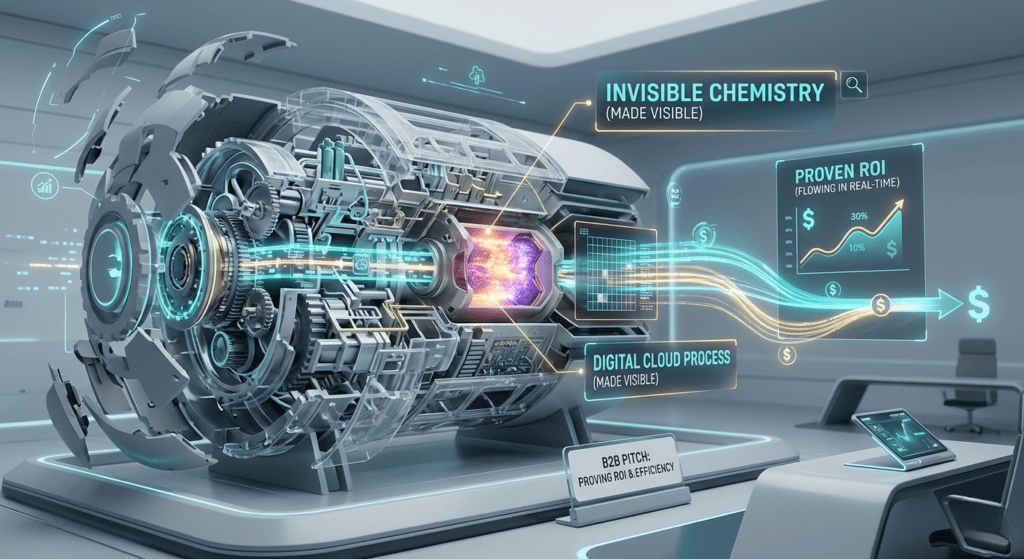
First up: animated explainers. These are the ultimate lifesavers for complex systems. When your technology happens inside a pipe, deep in a digital cloud, or involves a chemical reaction that can’t be seen by the naked eye, live-action won’t save you.
For the B2B Pitch: Use 3D “exploding” views. Show the internal engineering. Prove the efficiency. Make the CFO see the ROI flowing through the system in real-time.
For the B2C Consumer: Keep it clean, friendly, and lifestyle-focused. Use 2D and 3D animation to show how the product fits into their daily life. Focus on “plug and play,” not “chemical bonding.”
The secret to a viral-ready explainer isn’t the software; it’s the narrative arc. You have to architect the script around the friction and the freedom. If you spend 90 seconds on the chemical bond and only 10 seconds on why it saves the customer money, you’ve failed. Imagine a sleek animation where “waste” is represented by chaotic red lines that turn into calm, efficient green pulses as your software takes over. It looks premium, it feels high-tech, and it makes the concept instantly click.
2. The “Real-World” Documentary and Case Study
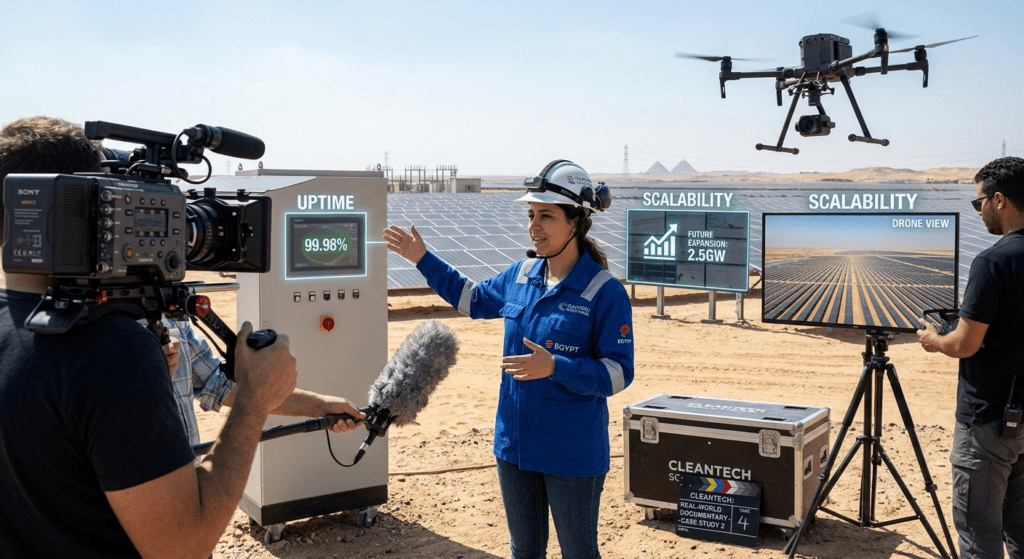
You have to ground that digital sophistication in physical reality. If you have a physical installation—be it a massive solar farm for a utility company or a single battery unit in a residential garage—you have to show it off.
The B2B Version: Go on-site. Interview the lead engineers and the client’s project manager. Talk about “uptime,” “integration,” and “scalability.” Use drone shots to capture the massive industrial scale.
The B2C Version: Focus on the “Saturday Morning” factor. Interview a real family. Is their house warmer? Is their bill actually lower? Do they feel like heroes?
Professional production is non-negotiable here. You need high-quality lighting to make an industrial setting look aspirational and drone permits to show the “Big Picture.” These videos serve as your “social proof” in its most potent, visual form.
3. Educational Videos – Teach, Inspire, Convert
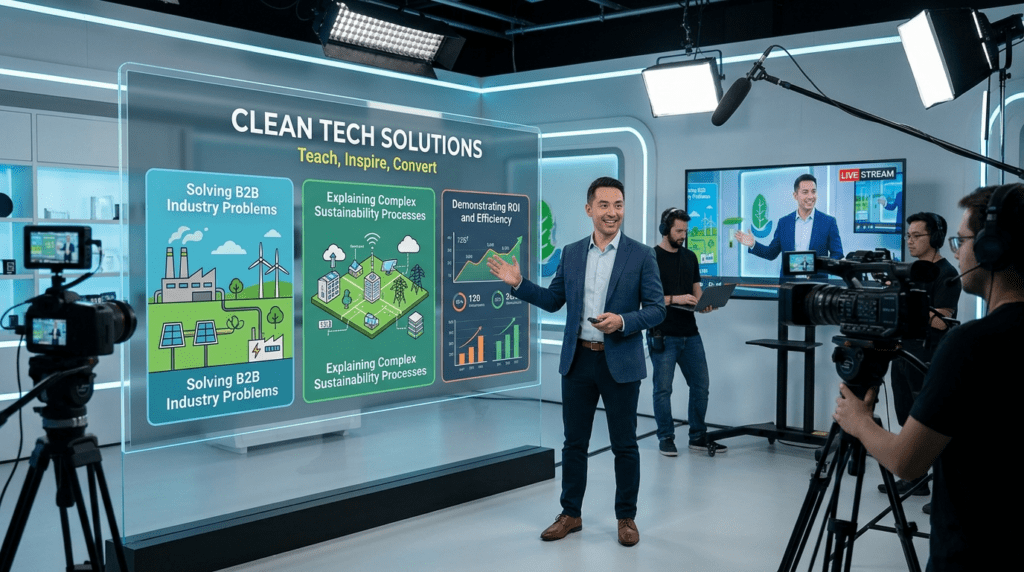
Educational videos are your secret weapon for connecting with both businesses and consumers. For B2B, these videos can showcase how your clean tech solutions solve industry-specific problems, explain complex sustainability processes, or demonstrate ROI and efficiency benefits.
For B2C, they can teach homeowners, eco-conscious buyers, or climate-aware individuals about practical green solutions, energy-saving tips, or the impact of adopting sustainable technologies.
The beauty of educational videos is that they position your brand as an expert while giving viewers real value. By helping your audience understand why your technology matters—and how to use it—you naturally build trust and engagement across all types of buyers.
Crafting a Story That Sticks (No Matter Who Is Watching)
Great clean tech marketing isn’t a list of specs; it’s a transformation story. You have to move from “what it is” to “what it allows the world to become.”
Stop Talking About Gigawatts
Seriously. Unless you’re talking to a grid engineer, nobody cares about the raw numbers. They care about the impact.
B2B: Don’t say “high thermal efficiency.” Say “This system reduces your operational overhead by 22% annually.”
B2C: Don’t say “low-carbon output.” Say “This allows your kids to grow up in a cleaner neighborhood.”
Features are for the manual; benefits are for the video.
The “Earth as the Hero” Script
If you want deep engagement, stop making your company the hero. Your customer is the hero. In this scenario:
The Hero (The Homeowner or the CEO) faces a Villain (Rising energy costs, grid instability, climate guilt). They encounter a Guide (That’s you). The Guide gives them a Tool (Your Science/Video Story). They achieve a New Reality (A sustainable, profitable future). It’s a proven psychological loop. Use it.
The Radical Transparency Rule
In 2026, transparency is the only antidote to greenwashing. Audiences—both B2B and B2C—can smell a “marketing spin” a mile away. Use video to pull back the curtain. Show the lab tests. Show the failures you overcame. Naturally weave in your third-party certifications like B-Corp status or ISO standards.
When you show the actual data on a screen within a video, it carries 10x the weight of a footnote in a brochure.
Distribution: Don’t Build a Ghost Town
A masterpiece doesn’t matter if it’s sitting on a hard drive. You need a dual-track distribution strategy.
LinkedIn: The B2B Powerhouse
For investors and industrial partners, LinkedIn is your primary theater. But don’t just dump a five-minute video there. Chop it into 15-second “Technical Nuggets.” Each clip should highlight one specific “aha!” moment.
Crucial Tip: Always use “burned-in” captions. Most B2B users are scrolling with the sound off during meetings or commutes. If they can’t read what you’re saying, they’re moving on.
Social: The B2C Battlefield
TikTok, Instagram, and YouTube Shorts. You have exactly three seconds to hook a homeowner before they swipe to a recipe video. Start with a punch to the gut: “Why is your house wasting $200 a month?” or “What if your house could pay you back?”
The Sales Funnel Integration
Embed your explainers on your landing pages. A video can boost conversion by 80%. Instead of a “Download Whitepaper” button, give them a “Watch the 60-Second Overview” button. Use the video to “hook” the fish, then offer the whitepaper for the deep-dive technical details.
Measuring Success: Beyond the “Vanity” View
How do you know if your videos are actually working?
You have to move beyond “likes” and track the KPIs that drive your business model.
The B2B Metrics:
Watch time and “heat maps” are your best friends. If your industrial partners are all dropping off at the 45-second mark when you talk about “modular integration,” your explanation is too complex. You need to simplify the visual. Track how many “Demo Requests” or “Whitepaper Downloads” come directly from that video landing page.
The B2C Metrics:
Click-through rate (CTR) and social shares. If homeowners are sharing your video with their neighbors, you’ve won. Monitor the “Conversion Rate” of your “Shop Now” or “Get a Quote” buttons. A/B test your thumbnails—sometimes changing a headline from “Save the Planet” to “Save $3,000 on Energy” changes everything.
The Bottom Line
At the end of the day, turning your complex science into viral video stories isn’t a “nice-to-have” luxury; it’s a business necessity. If people don’t understand you, they can’t buy from you.
Stop hiding behind dense, uninspired PDFs that gather digital dust. Start showing your impact. Start visualizing your innovation. By marrying the rigor of your science with the punch of a digital marketing pro, you don’t just inform your audience—you inspire them to act. Video is the only medium that can scale the trust you need to actually change the world.
So to recap Clean tech companies can turn complex science into viral video stories by:
- Using animated explainers to make invisible processes clear.
- Showing real-world impact through case studies and documentaries.
- Highlighting benefits over technical features.
- Applying storytelling where customers are heroes and tech is the guide.
- Distributing strategically on LinkedIn for B2B and social Shorts for B2C.
- Measuring success with demo requests, conversions, and watch time.
Videos that combine technical rigor with clear, engaging narratives educate, inspire, and drive measurable results.
Now, go get a camera.