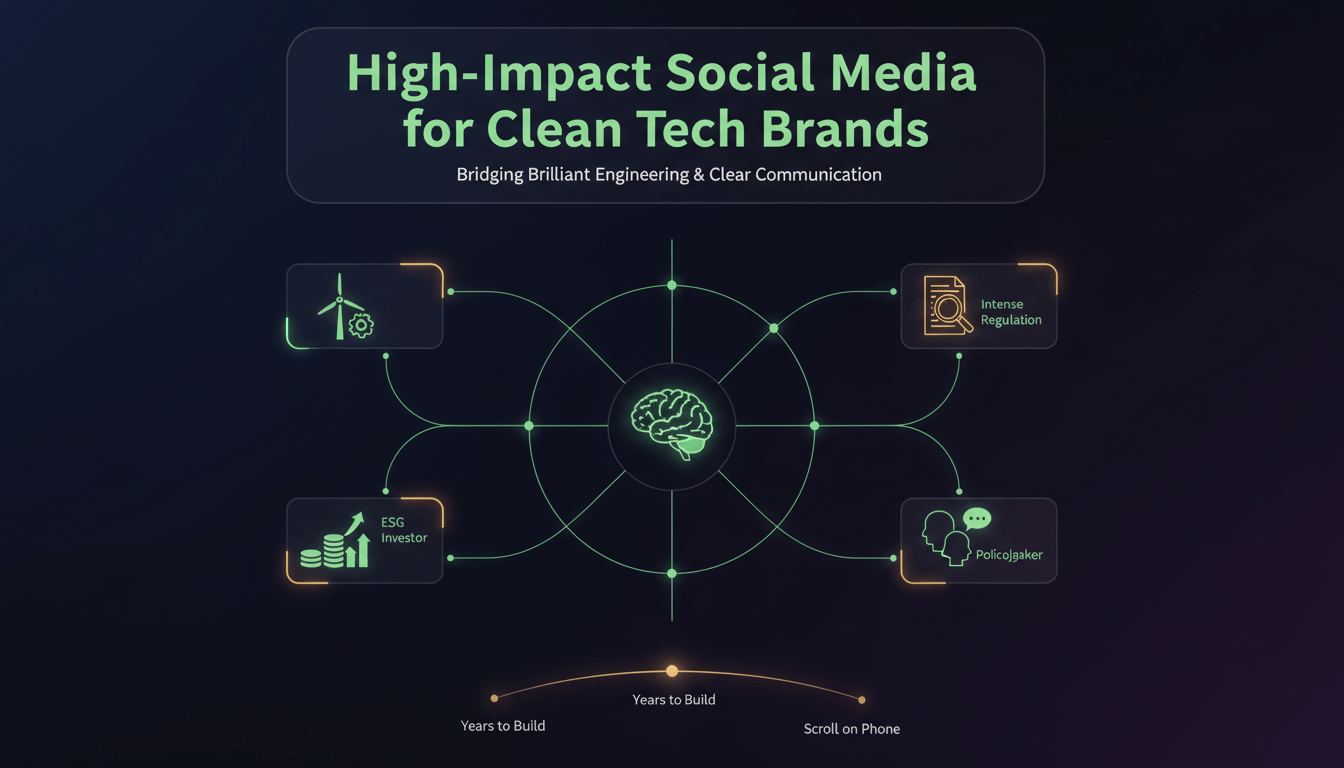
If you’ve spent any time marketing clean tech, you already know the painful truth. This isn’t like selling a new productivity app or a trendy B2C subscription box. We are operating in a world defined by massive stakes, intense regulation, and hardware that takes years to build.
You’re constantly trying to bridge the gap between brilliant engineering and clear communication. It’s a struggle to translate high-level technical jargon into something a person can actually scroll through on their phone. You have to be a translator as much as a marketer.
Then there is the audience problem. You aren’t just talking to one person. You’re trying to catch the eye of an ESG investor one minute and a skeptical municipal policymaker the next. It’s a delicate balancing act that requires a high degree of precision.
We also can’t ignore the elephant in the room: climate anxiety. People are tired of the “doom and gloom” narrative. If your content only focuses on the crisis, people will tune you out. They want to see the “how” behind the solution.
The key to winning in this space is moving away from generic awareness. You need a closed-loop social funnel. This is a system where your social efforts feed directly into your business goals, and your data feeds back into your content strategy.
Rethinking the Funnel for the Energy Transition
Most people treat social media like a megaphone. They shout their news into the void and hope someone clicks a link. But in clean tech, where the sales cycle can span years, that “shout and pray” method is a recipe for failure.
A closed-loop funnel is about building a ecosystem. Every post you put out should serve a specific purpose in a much longer journey. We aren’t just looking for a “Like.” We’re looking for technical validation and long-term trust.
Think about the way a buyer moves through an infrastructure deal. They don’t just see a post and sign a multi-million dollar contract. They see a post, they check your LinkedIn, they download a whitepaper, and they talk to their engineers.
Your social funnel needs to account for all of that. It’s about creating touchpoints that nurture a prospect through the research phase. You want to be the brand that helped them understand the complexity of the grid before they even talked to a salesperson.
This approach creates a feedback loop. When you see which technical topics are getting the most traction, you know what your sales team should be talking about. You’re using social media as a real-time market research lab.
The Reality of Choosing the Right Platforms
I hear people say you need to be everywhere, but in this industry, that’s just a fast way to burn your budget. You have to be where the decision-makers are actually doing their research. For us, that starts and ends with LinkedIn.
LinkedIn is the heavy lifter. It’s where the institutional investors and project developers spend their time. But you can’t just treat it like a corporate bulletin board. You have to provide actual, tangible value in the feed.
I always recommend using LinkedIn Document posts. If you have a sustainability report or a technical case study, don’t just link to it. Upload the PDF as a carousel. Let people read the data without leaving the platform.
The LinkedIn algorithm loves this because it keeps users engaged. But more importantly, the users love it because it’s frictionless. You’re giving them the high-fidelity data they need exactly where they already are.
Then you have X and Instagram, which serve very different roles. Think of X as the town square. It’s where the “Climate Tech” hive mind lives. If there is a major policy shift or a global summit, that’s where the conversation happens.
Instagram is your “show, don’t tell” platform. Clean tech is often criticized for being “vaporware.” People want to see the hardware. They want to see the solar panels, the turbines, and the labs where the magic happens.
Use Instagram to give people a look behind the curtain. Show the “grit” of the installation process. Use Reels to humanize the scientists. It builds a level of visual proof that a glossy brochure just can’t match.
Building Content That Actually Converts
A great strategy dies without great content. In clean tech, your content pillars need to be rooted in two things: education and radical transparency. If you can’t explain your tech simply, people will assume it doesn’t work.
Translating the Technical for the Human Brain
Our products are often complex and, frankly, a bit invisible to the average person. Most people don’t think about grid frequency or carbon sequestering until something goes wrong. Your job is to make them care by making it understandable.
I love using short-form technical explainer videos. Take a sixty-second clip and break down one specific part of your tech. Use simple animations to show the flow of energy or the way a new material behaves.
Don’t just say your technology is “innovative.” That word has lost all meaning. Show the data. Show how it compares to the legacy systems we’ve been using for the last fifty years. Context is everything in this game.
The Power of Radical Transparency
We also need to talk about the “Build in Public” movement. In an industry as high-stakes as ours, being “too polished” can actually backfire. It can make you look like you’re hiding something or overpromising on your results.
Don’t be afraid to talk about the stuff that isn’t going perfectly. If an R&D milestone got pushed back, explain why. If you’re struggling with a supply chain issue for specific minerals, talk about how you’re solving it.
This kind of honesty is incredibly refreshing to investors and partners. It shows that you’re a real engineering firm dealing with real-world physics. It builds a level of trust that you simply cannot buy with a fancy ad campaign.
Humanizing the Lab Coat
Finally, you have to show the people. Clean tech is driven by some of the smartest, most passionate people on the planet. Why wouldn’t you feature them? Introduce your engineers and your site technicians to the world.
When a potential client sees the face of the person who designed the system, the relationship changes. It’s no longer a transaction with a faceless corporation. it’s a partnership with a team of experts who care about the mission.
The High Cost of Greenwashing
I can’t stress this enough: one bad claim can destroy years of brand building. Greenwashing is the ultimate “funnel killer.” In the social media age, there are thousands of people waiting to fact-check your every move.
You have to move past “marketing speak.” Terms like “eco-friendly” or “green” are too vague. They invite scrutiny without providing any real information. You need to be precise and, quite frankly, legally careful.
Make sure you understand the nuances between terms like “carbon neutral” and “net zero.” These aren’t just synonyms; they have very specific technical and legal definitions. Using them incorrectly can lead to serious regulatory trouble.
Every single claim you make on social media needs to be backed by a “receipt.” If you say you saved a certain amount of emissions, have the data ready. Link to the third-party certification or the internal audit that proves it.
I always tell my clients to set up a “Scientific Review” process for social media. Before a post goes out, an engineer or a sustainability expert needs to sign off on the copy. It might slow things down, but it protects your reputation.
In this space, your integrity is your most valuable asset. Once you lose the trust of the scientific community or the regulators, it is incredibly hard to get back. Accuracy is your best marketing strategy.
Moving Past Vanity Metrics
If you want to know if your funnel is working, stop looking at “Likes.” They don’t pay the bills and they don’t move the needle on climate change. You need to look at what I call “High-Intent Actions.”
Is your technical content getting saved? On LinkedIn, “Saves” are a huge indicator of value. It means someone found your data so useful they wanted to keep it for later. That is a much stronger signal than a quick “Like.”
You also need to be tracking attribution. Use UTM codes for every link you share. This allows you to see exactly which post led to a whitepaper download or a demo request in your GA4 dashboard.
Then there is the concept of “Dark Social.” In the B2B world, the most important conversations happen in private. An engineer sees your post and DMs it to their boss. A policymaker emails your video to their committee.
You can’t track every single one of those moves, but you can see the results. Keep an eye on your “Share of Voice.” Are you the brand people mention when they talk about your specific niche? That’s how you know you’re winning.
The Big Picture: Marketing for a Better Future
Building a closed-loop social funnel for a clean tech brand is a marathon, not a sprint. It’s about being the most helpful, most transparent, and most accurate voice in the room. It’s a specialized discipline for a specialized industry.
By focusing on LinkedIn for authority and using visual platforms for proof, you create a balanced presence. You reach the people who sign the checks and the people who influence the public narrative.
When you back all of that up with real data and a refusal to participate in greenwashing, you become bulletproof. You aren’t just a company with a product; you’re a leader in a global movement.
Ultimately, social media is the most powerful tool we have for scaling the energy transition. It allows us to educate at scale and build trust at speed. When you close the loop between your content and your mission, everyone wins.
The goal is to turn digital engagement into real-world impact. By being human, being honest, and being technical, you transform your social media into a driver of sustainable growth. That is how you build a brand that lasts.